Lapomik Energy Group — Renewables & Gas

SCADA · PPC · EMS integration for renewable and hybrid plants

The control layer for renewable plants.

Lapomik Energy is a SCADA integrator for solar, storage, hybrid and mini-grid plants. We engineer, validate and commission the plant control system, then give operators one platform — VETRA — to monitor, control and aggregate every asset, whatever the OEM.

Vendor-neutralAny inverter, battery, genset, meter or relay under one plant master
Grid-code-ready PPCDesigned to align with IEC 61850, IEC 60870-5-104, IEEE 1547 and applicable national grid codes
Validated before siteSimulation-based validation, then factory and site acceptance with signed records
Hybrid plant · PV + BESS + Grid + Gas → LoadSimulated day cycle

What operators get from VETRA

Every OEM ships a controller for its own equipment. A plant needs one system above them all. VETRA is that system — it monitors, controls and aggregates — and we integrate, test and support it as a documented engineering scope.

Monitor

Real-time telemetry, alarm management designed to align with ISA-18.2, historian and reporting, HMI screens built on ISA-101 principles, availability and performance ratio per plant and per fleet.

Control

Power plant control at the point of interconnection — active and reactive power, voltage, frequency, ramp rates — and hybrid EMS dispatch across PV, storage, gensets and grid, including islanding and black start. Protection and interlocks stay in the relays.

Aggregate

One normalised data model across OEMs and sites: fleet KPIs, contracted-performance tracking and northbound interfaces to utilities, owners and lenders over IEC 60870-5-104, DNP3, OPC UA, MQTT and REST.

Assure

Simulation-based validation, factory and site acceptance, grid-compliance testing, OT cybersecurity designed to align with IEC 62443, and a documentation package the owner can audit.

Built for demanding sites. Ready for the world.

Local engineering, international standards, and control systems designed for weak grids, harsh environments and fuel-constrained sites.

Engineering close to the plant

In Nigeria, a Port Harcourt engineering team that understands emerging energy markets, working to international IEC standards so the result is both reliable and compliant.

Vendor-agnostic, OEM-neutral

VETRA integrates with any inverter, battery, genset, meter or relay. No black-box lock-in: you own your data, your logic and your future.

Grid-code-ready control logic

Power plant control designed to meet grid codes and utility requirements, validated in simulation before it reaches the point of interconnection.

Carbon-credit-ready data

Diesel displacement, emissions avoided and generator runtime captured automatically, supporting Verra- and Gold-Standard-aligned reporting workflows.

Designed for weak grids

Islanding, black start and offline-first operation for sites with intermittent grid and connectivity.

Bankable by construction

Controlled documentation, signed test records and investor-grade data that keep a project financeable after commissioning.

Our philosophyEngineering-first approachVendor neutrality and opennessLong-term reliability and performanceLocal capacity building

Integration services

The full control-system scope of a renewable or hybrid plant, delivered as engineered packages with acceptance criteria — whether we are the SCADA contractor to an EPC, the integrator for an owner, or the independent engineer for a lender.

OT network cabinet with managed switches and fibre patch panel
Illustrative render

SCADA design and integration

System architecture, redundant servers, HMI and historian, tag database and I/O lists, device integration across every OEM on site.

Power plant controller (PPC)

Grid-code control at the point of interconnection: P/Q/V/f setpoints, ramp-rate and curtailment logic, utility interface and compliance testing.

Hybrid EMS

Cost- and reliability-based dispatch of PV, storage, gensets and grid; state-of-charge management, fuel-saving modes, islanding and black start.

Substation and RTU automation

IEC 61850 integration with protection relays and switchgear; IEC 60870-5-104 and DNP3 links to system operators; RTU and gateway engineering.

Communications and OT network

Fibre, radio and LTE designs, ring topologies, managed switching and segmentation sized for sites with intermittent connectivity.

OT cybersecurity

Zones and conduits, hardened remote access, monitoring, backup and incident response — designed to align with IEC 62443 and IEC 62351.

Simulation-based control validation

Control logic proven against simulated faults, outages and grid events before it reaches site.

FAT, SAT and commissioning

Factory and site acceptance with signed records, performance validation, grid-compliance tests and structured handover.

Legacy SCADA migration and retrofits

Replace or upgrade an OEM or end-of-life SCADA, add a PPC or EMS to an operating plant, add genset monitoring — without stopping production.

Remote operations and O&M support

Remote Operations Centre supervision for single plants and fleets, Level 1 and Level 2 support, preventive and corrective maintenance.

Owner's engineering and review

Independent review of SCADA, PPC, EMS, network and cybersecurity packages, vendor submittals and test procedures for owners and lenders.

Training and capacity building

Operator and engineer training on a live hybrid plant in Port Harcourt, plus project-specific handover training.

VETRA — Monitor. Control. Optimize. Transform.

One platform for operators: monitor, control, aggregate

VETRA is Lapomik Energy's SCADA, PPC and EMS platform. Operators use it to monitor and control a plant in real time and to aggregate data across OEMs and sites into one model. Each OEM controller remains the final executor of its own device; VETRA is the plant master above them — and control never depends on the cloud.

Illustrative render — VETRA operations view
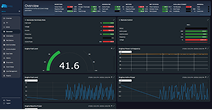
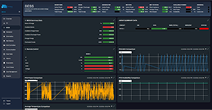
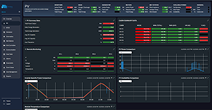
VETRA dashboard sample

Sample VETRA dashboards shown with anonymised data.

Edge / on-premise

Redundant plant servers or a DIN-rail industrial controller with an IEC 61131-3 runtime. Control, protection interfaces and the historian run on site.

Cloud

Fleet Manager for multi-site aggregation, reporting and secure remote access through a DMZ — for owners, programmes and lenders.

Hybrid (default)

Edge control with cloud aggregation: the plant keeps operating through a connectivity loss and back-fills data when the link returns.

Platform

VETRA SCADA · PPC · EMS

Plant supervision, grid-code control at the point of interconnection (active/reactive power, frequency, voltage, ramp rates) and cost-optimised dispatch across PV, storage, gensets and grid.

Fleet

Fleet Manager

One operations view across every site in a portfolio: availability, energy served and consumed, alarms, fuel, and contracted KPIs per site and per programme.

Data

Data Aggregation Platform

A normalised time-series and event layer for inverters, BMS, gensets, meters, weather stations and third-party systems, so different OEM data behaves as one dataset.

Gensets

VETRA DGM

Diesel and gas generator monitoring: fuel level and consumption, run hours, loading, starts and health — the fastest route to visible operating savings.

Twin

GridTwin

A digital twin of the plant for simulation, what-if analysis and clause-by-clause grid-code checks before a controller setting ever reaches the field.

AI

VETRA Intelligence

An energy copilot that observes, explains, predicts and recommends with evidence and confidence. It never holds final control authority; deterministic protection and grid-code layers do.

Assurance

Validation in simulation

Control logic validated in simulation against faults, outages and grid events prior to deployment, with a signed record.

Security

VETRA Shield

OT cybersecurity designed to align with IEC 62443 and IEC 62351: zones and conduits, hardened remote access, monitoring, backup and incident response.

Support

Support Portal

Ticketing, service history, documentation and SLA tracking for every site, with remote-first Level 1 and Level 2 support from Port Harcourt.

Interfaces

Southbound to equipment and northbound to utilities, regulators and owner systems.

  • PV, storage, gensetsSunSpec Modbus, Modbus TCP/RTU, IEC 61850, CANbus, SAE J1939
  • Utility and system operatorIEC 60870-5-104, DNP3 (IEEE 1815), IEC 61850
  • Owner systems and cloudOPC UA, MQTT, REST APIs, webhooks
  • Driver library73 equipment drivers in the current Modbus library; new devices are added per project

Ask the plant

VETRA Intelligence answers in plain language and always shows its evidence. Sample exchanges below are illustrative.

Sample responseSelect a question

Every answer carries an explanation, a confidence indicator, a timestamp and links to the supporting data — never a bare conclusion.

VETRA Hybrid Control — Blend. Reserve. Island. Control.

One control platform, from fuel-save to full microgrid

Intelligent power, controlled for performance. The VETRA controller family is a ladder: start with the class the site needs today, and move up when storage, a grid connection or islanding is added — without changing platform, screens or support desk.

Fuel-save

VETRA Blend

PV + gensets

Solar-diesel control for sites that run on generators. Blend pushes solar as far as the gensets safely allow and gives the fuel saving back as a measured number.

  • Genset minimum-load protection and reverse-power prevention
  • Zero-export and curtailment with ramp control
  • Fuel-save reporting against a measured baseline
VB-100VB-200VB-500VB-1000VB-3000
Storage microgrid

VETRA Reserve

PV + BESS + backup genset

Storage-led sites where the battery carries the load and the generator is the reserve. Reserve manages state of charge and calls the genset only when it is needed.

  • State-of-charge window and charge/discharge limits
  • Genset auto-start and stop on state of charge
  • VR-100 for one backup genset, VR-200 for two
VR-100VR-200
Full microgrid

VETRA Island

PV + grid + BESS + gensets

The complete microgrid controller: grid-connected and islanded operation, controlled transfer between them, and black start when everything is down.

  • Islanding detection, transition and resynchronisation
  • Black start and source sequencing
  • Cost- and reliability-based dispatch across every source
VI-SVI-MVI-L
Above the ladder

VETRA H-PPC

Hybrid power plant controller

For larger and grid-code-bound plants beyond the Island range: plant-level control at the point of interconnection, engineered per project with full SCADA.

  • Active/reactive power, voltage, frequency and ramp-rate control
  • System-operator interface and compliance testing
  • Redundant architecture and project documentation package
Engineered per project

Class limits, supported equipment and register maps are fixed in the datasheet and confirmed against your equipment list before any quotation. No performance figure is quoted without the site data behind it.

Add-ons on every class

Every controller in the family opens onto the same platform. Add what the site or the portfolio needs.

Fleet Manager

Multi-site view, reporting and secure remote access. Basic, Pro and Pro + API editions.

VETRA Insight

Performance and engineering analytics on the plant's own data.

VETRA DGM

Generator and fuel monitoring for every genset on site.

VETRA Shield

OT cybersecurity: zoning, hardened remote access, monitoring and backup.

Data Aggregation & Settlement

Validated energy data, settlement and the invoice lifecycle.

VETRA Intelligence

The energy copilot: explains, predicts and recommends with evidence.

GridTwin

Digital twin for what-if analysis and settings checks before the field.

VETRA Care

Support, software and maintenance subscription after commissioning.

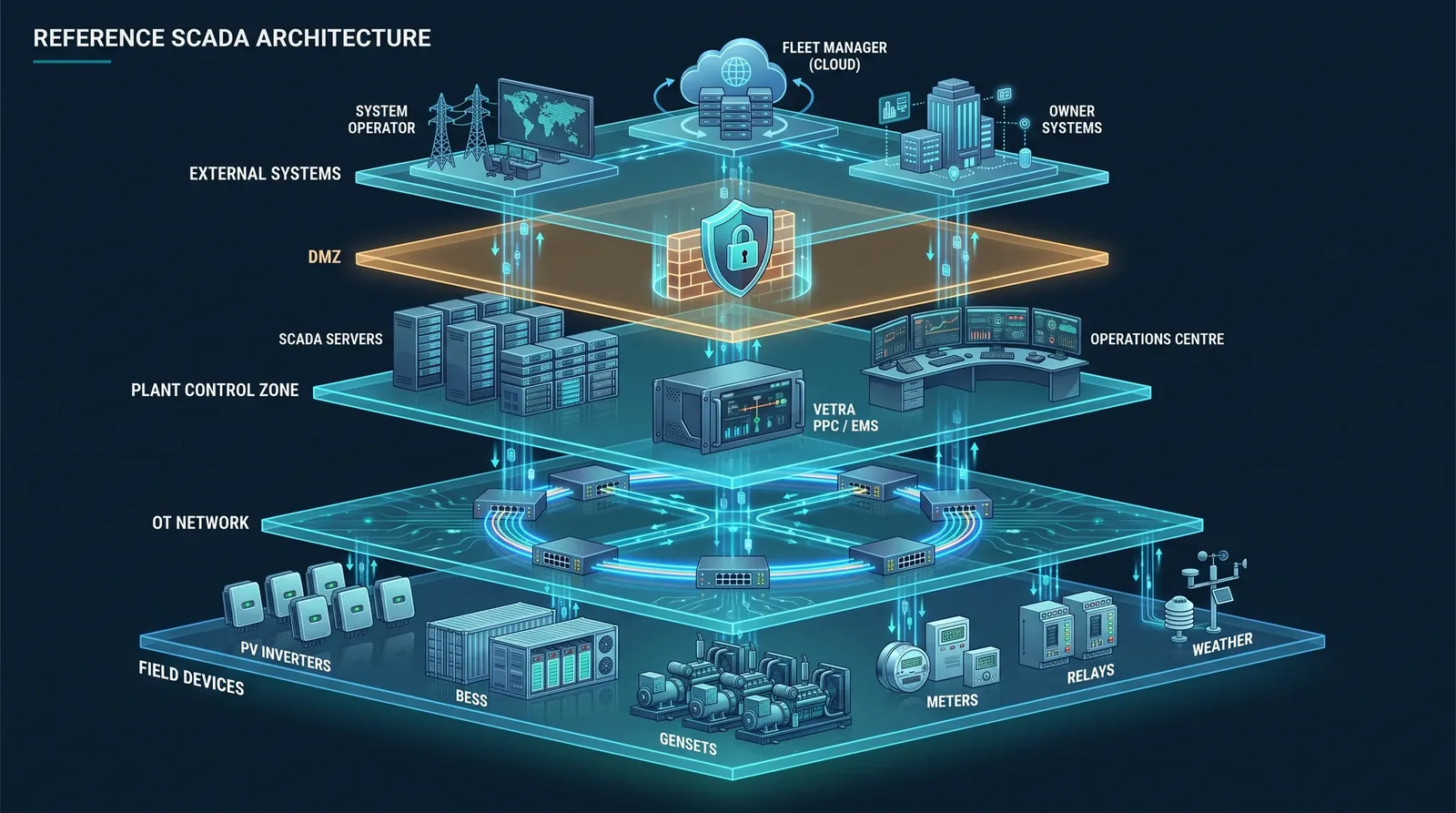
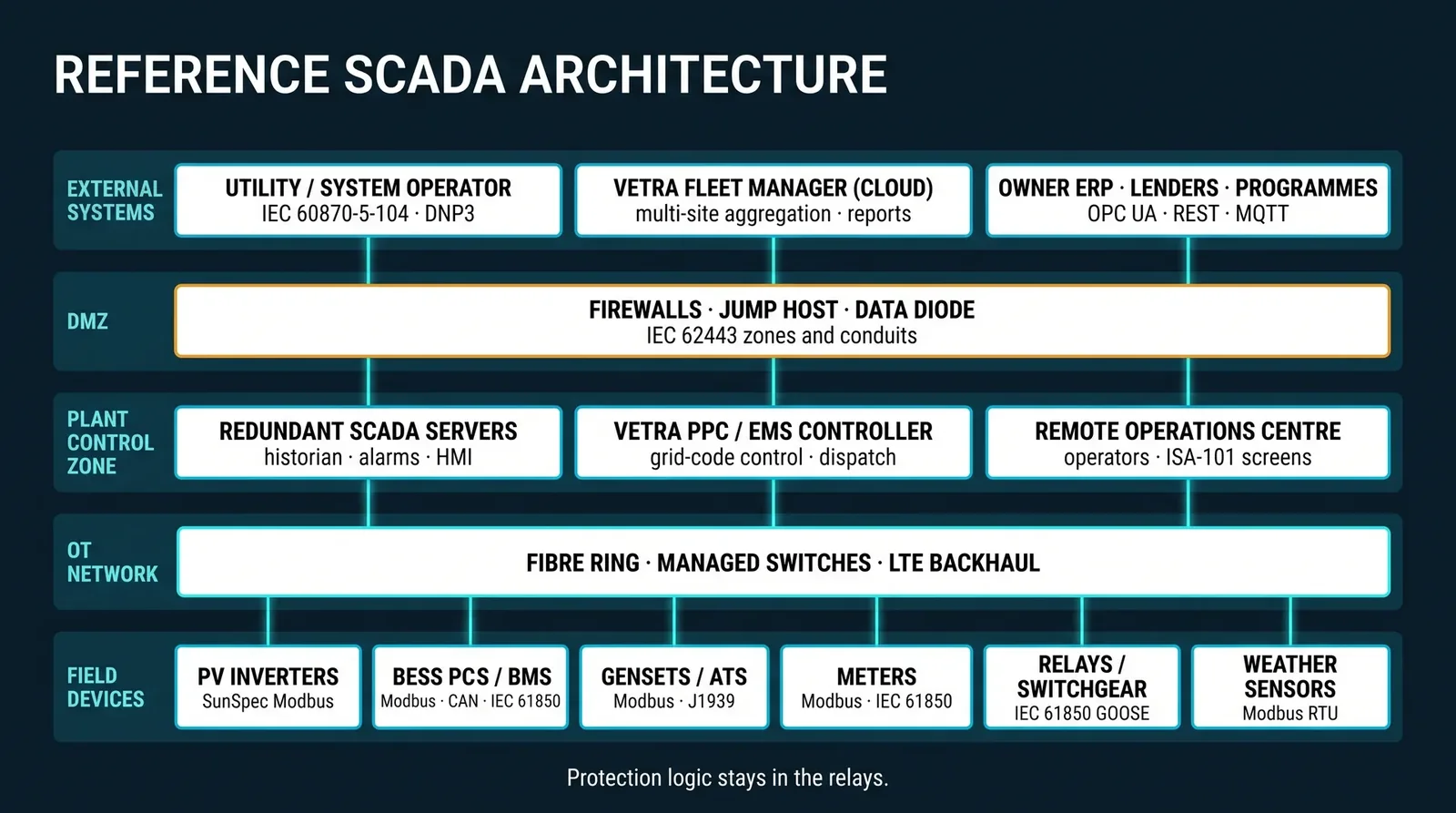
Reference SCADA architecture

A typical plant as we deliver it: field devices on open protocols, a segmented OT network, redundant plant control with VETRA as the master, a DMZ, and external interfaces to the system operator, owner and lenders. Every project gets its own version of this drawing.

Reference SCADA architecture: field devices, OT network, plant control zone, DMZ and external systems
Reference architecture, illustrated. Protocol assignments and zone boundaries are on the engineering drawing. Open full size

Protection logic stays in the relays. Nothing in the DMZ or above it can issue a breaker command; supervisory setpoints pass through the PPC/EMS with limits, interlocks and audit logging.

Live demonstration · simulated

Operate a hybrid plant

Move the load, cut the sun, drop the grid. The dispatch logic below follows the same merit order VETRA applies on a real plant: solar first, battery second, grid third, gas last — and every decision is visible.

Controls

Grid available
Scenarios
Assumptions (illustrative, editable)
PV capacity, MWp
BESS power, MW / energy, MWh
Gas generator capacity, MW
Grid energy, cost/kWh
Gas generation, cost/kWh
Battery cycling, cost/kWh
Grid carbon, kgCO₂/kWh
Gas carbon, kgCO₂/kWh

Plant one-line view Grid-connected

    Live figures

    Generation
    0.0MW
    Consumption
    0.0MW
    Battery SOC
    60%
    Gas utilisation
    0%
    Energy cost
    0/h
    Carbon
    0kg/h
    Solar
    0.0 MW
    Battery
    0.0 MW
    Grid
    0.0 MW
    Gas
    0.0 MW

    Asset health

      Renewable share of load served: 0% Request a proposal for this configuration Simulation runs in your browser; it is not connected to live infrastructure. Unit costs and carbon factors are illustrative placeholders for you to edit.

      Services

      Data aggregation, settlement, invoicing and payments

      When an operator is paid for energy delivered and availability achieved, the data is the contract. We aggregate it, validate it, settle it and carry the invoice through to reconciliation — so owners pay for what was delivered and operators are paid for what they delivered.

      Aggregation

      Meter, inverter, battery and genset data from every OEM and every site normalised into one model, with gaps flagged rather than hidden.

      Settlement engine

      Contracted energy, availability targets, penalties and performance certificates calculated from validated data under the rules of each agreement.

      Three-way validation

      Operator claim, platform record and owner verification compared before any amount is approved. Estimated data is never presented as measured.

      Payments

      Approved invoices move to payment through a secure payment provider, then reconcile back to the settlement period.

      Governance

      Role-based approvals, a full audit trail and dispute handling, so every figure can be traced to its source reading.

      OT / finance separation

      Settlement reads plant data; it cannot write to a plant. Financial users never sit on the control network.

      Invoice lifecycle

      1. Draft
      2. Submitted
      3. Under validation
      4. Owner review
      5. Approved
      6. Payment processing
      7. Paid & reconciled

      VETRA Settlement & Availability Audit

      A fixed-scope entry engagement for independent power producers, developers and programme owners: we take a period of your plant data, rebuild energy delivered and availability from source readings, and report where the numbers and the invoices disagree.

      Ask about an audit

      VETRA VPP — virtual power plant

      Many sites, dispatched as one plant

      A virtual power plant aggregates distributed solar, storage, gensets and flexible load across many sites and dispatches them as one resource. VETRA VPP is the aggregation layer we are building on top of the controllers already in the field — so a site commissioned on Reserve, Island or H-PPC today is a VPP-ready asset tomorrow.

      Site first, fleet second

      A VPP request never overrides site protection, battery limits, genset rules or the customer's own load. Optimisation does not outrank equipment or customer safety.

      Fail-safe by design

      If the link to the platform is lost, each site falls back to its local operating mode. Control never depends on the cloud.

      Deterministic dispatch

      Requests are scheduled, signed and logged. Every dispatch has a record of what was asked, what the site accepted and what was delivered.

      Settled on measured data

      Delivered flexibility is verified from metered data and carried through the same validation and invoice lifecycle as our settlement service.

      Secured end to end

      Device identity, signed commands and zoned networks, designed to align with IEC 62443. Financial and market users never sit on the control network.

      Open by intent

      A canonical model across OEMs today; open demand-response and DER interfaces are on the roadmap, confirmed per programme.

      Phased path

      Foundations
      • Canonical asset model across the fleet
      • Device identity and signed commands
      • VPP dispatch mode on the site controller
      First fleet
      • Behind-the-meter commercial and industrial sites
      • One counterparty, one agreed service
      • Programme-agreed measurement and verification
      Phase 2
      • Forecasting of solar, load and availability
      • Open demand-response interfaces
      • Electric-vehicle charging as flexible load
      Phase 3
      • Smaller and residential assets
      • Grid services, where the market and regulation allow

      Status: in development. VETRA VPP is described here as direction, not as an operating service; participation in any market or programme depends on the applicable regulation and licensing. Portfolio owners, utilities and programme sponsors interested in a first fleet are invited to get in touch.

      VETRA EMS for data centres — Control the power. Protect the uptime. Reduce the cost.

      The energy control layer for data centres

      A data centre already has a UPS, a building management system and a generator controller — each looking after its own equipment. What it rarely has is one system deciding which source should carry the load, at what cost, with what reserve. VETRA EMS is that layer: it orchestrates utility, gensets, storage and solar around the critical load, and leaves protection and the UPS transfer path exactly where they are.

      Source orchestration

      Utility, gensets, storage and solar dispatched on cost and reserve, with redundancy (N, N+1, 2N) treated as a constraint the EMS never trades away.

      Genset and fuel security

      Sequencing, loading and run-hour balancing, plus VETRA DGM for tank levels, consumption, refills and autonomy in hours at the present load.

      Storage and UPS coordination

      Battery storage used for peak shaving, ride-through support and genset start bridging. The UPS and its static transfer path remain the final protection for the IT load.

      Solar and tariff optimisation

      On-site PV integrated without disturbing the critical bus; time-of-use and demand charges managed where the tariff rewards it.

      Efficiency and tenant data

      PUE and energy KPIs by hall, by system and by tenant; sub-metering and allocation data ready for billing and sustainability reporting.

      Resilience and recovery

      Controlled transfer, load-shed priorities and black-start sequencing, rehearsed in simulation before they are needed on the floor.

      Open integration

      Modbus, SNMP, BACnet, OPC UA, IEC 61850 and REST to BMS, DCIM and owner systems. Supported points depend on the interfaces your equipment exposes.

      OT cybersecurity

      VETRA Shield: zones and conduits, hardened remote access and audit logging, designed to align with IEC 62443. The energy network stays separate from tenant IT.

      Operations and support

      Remote Operations Centre supervision and a VETRA Care plan, with response targets written into the agreement.

      Three ways to engage

      • Control platformVETRA software and integration on your existing plant, as a subscription with integration services.
      • Turnkey EMSDesigned, supplied, validated in simulation, commissioned and handed over with a full documentation package.
      • Energy-as-a-servicePerformance-based, measured against a jointly agreed baseline.

      How we start

      1. Site survey
      2. Baseline period
      3. Design and simulation
      4. Pilot hall or site
      5. Baseline vs optimised report
      6. Roll-out

      We do not quote a percentage saving before we have your site data. Every figure in a proposal is either measured at your facility or labelled illustrative. Also available for telecom-tower portfolios, where hundreds of small sites are run as one fleet.

      VETRA EV — charging energy management

      Electric vehicles, charged by a site that can carry them

      An electric fleet is a large new load on a supply that was never sized for it. On a weak or expensive grid, the question is not which charger to buy but where the energy comes from, when, and at what cost. VETRA EV treats chargers as one more controllable asset on the site — beside solar, storage, gensets and the grid — so vehicles are ready when they are needed and the site never trips to get them there.

      Dynamic load management

      Charging power shared across bays within the site's connection and transformer limits, so adding chargers does not mean upgrading the supply first.

      Solar-first charging

      Vehicles that are parked through the day absorb the solar the site would otherwise curtail; charging follows the sun where the schedule allows.

      Storage-buffered fast charging

      Battery storage delivers the short, high peaks of DC charging and refills slowly — fast charging on a connection that could not supply it directly.

      Ready-by scheduling

      Each vehicle gets the energy it needs by its departure time, in priority order, at the lowest cost the tariff and the sources allow.

      Weak-grid and off-grid hubs

      Charging continues through grid outages on solar, storage and gensets, with genset running kept to the minimum the schedule requires.

      Measured, per vehicle

      Energy, cost and carbon per vehicle and per kilometre, with the fuel displaced stated against a measured baseline — the same discipline we apply to CNG fleets.

      Who it is for

      • Fleet depotsLogistics, buses, staff transport and last-mile delivery.
      • Workplaces and campusesFactories, offices, hospitals, hotels and estates adding charging to a captive plant.
      • Charging hub developersPublic and highway hubs where the grid connection is the constraint.
      • Two- and three-wheelersBattery-swap and charging stations with many small batteries on one supply.

      One clean-mobility path

      Fleets rarely change fuel all at once. Lapomik supports the mix: compressed natural gas for the vehicles that suit it today, electric for those that suit it next — measured on the same platform, so the finance team compares like with like.

      1. Measure the fleet
      2. Convert to CNG where it pays
      3. Electrify where it fits
      4. Charge from the site's own energy
      5. Offer parked vehicles as flexible load

      Status: in development. EV charging management is being added to the VETRA EMS and is offered today as an engineered project scope; charger compatibility is confirmed per project against the interfaces each charger exposes. Vehicle-to-grid is on the longer roadmap and depends on vehicle, charger and regulatory support. No savings figure is quoted without the fleet's own data.

      Plant types and sectors we integrate

      From a 200 kW captive plant to a utility-scale interconnection, the control-system scope changes in size, not in discipline — and every sector that runs on generators, grid or solar needs the same three things: to monitor, control and aggregate.

      Rooftop solar and battery installation on a hotel in Port Harcourt
      Illustrative render

      Utility-scale solar

      Plant SCADA, PPC at the point of interconnection, system-operator telemetry and grid-compliance testing.

      Battery storage and PV + BESS

      PCS/BMS integration, state-of-charge and thermal supervision, frequency and voltage support, firming and peak shaving.

      Hybrid mini-grids (PV + BESS + DG)

      EMS dispatch, genset sequencing, islanded operation and black start; programme KPIs for RESCOs and regulators.

      Commercial and industrial captive plants

      Rooftop and ground-mount PV with storage and gensets behind the meter; fuel and cost dispatch; VETRA DGM for existing gensets.

      Telecom and distributed sites

      Hundreds of small sites aggregated in Fleet Manager with common KPIs, alarms and fuel tracking.

      Substations and interconnections

      IEC 61850 relay integration, RTU gateways and IEC 60870-5-104 / DNP3 links to the transmission or distribution operator.

      Sectors we serve

      Every sector that needs power. The plant differs; the control discipline does not.

      Mining and quarrying

      Remote captive plants with large motor loads and long fuel supply lines. Hybrid PV, storage and genset dispatch, sequencing and fuel accounting per pit and per camp.

      Hospitality

      Hotels, resorts and serviced apartments where guests notice every flicker. Generator monitoring first, then rooftop solar and storage, with consumption per building and per wing.

      Healthcare

      Hospitals, clinics and diagnostic centres: critical loads, transfer sequences, oxygen plants and cold chain, with audited availability for boards and funders.

      Manufacturing and industrial

      Factories, breweries, food and beverage, plastics, textiles: process continuity, power quality and cost-based dispatch that keeps the line running through grid loss.

      Cement, steel and heavy industry

      Large captive gas and diesel plants with medium-voltage distribution: relay integration, load-shedding schemes and plant-wide SCADA.

      Oil and gas

      Upstream, midstream and oil-servicing facilities and camps: hybrid power, fuel monitoring and OT-grade cybersecurity at every site.

      Agriculture and agro-processing

      Farms, cold stores, mills and agro-processing zones: irrigation pumping and processing loads on solar-diesel hybrids, with seasonal dispatch profiles.

      Telecom

      Tower sites and data hubs: hundreds of small plants aggregated in Fleet Manager with fuel, battery health and alarms per site.

      Data centres

      Resilient hybrid supply with black start, controlled transfer and fuel security, reported to the standard the tenants require. VETRA EMS for data centres

      Commercial real estate and estates

      Offices, residential estates and gated communities on shared plants: tenant sub-metering, allocation and billing data from the same platform.

      Retail and malls

      Supermarkets, malls and cold-chain retail: peak shaving, generator monitoring and energy cost per outlet.

      Banking and finance

      Branches and head offices: uninterrupted power for operations and a fleet view of every branch generator.

      Education

      Universities, campuses and schools: multi-building distribution, laboratory loads and programme reporting.

      Government and public institutions

      Ministries, secretariats, hospitals and schools under electrification programmes, with energy served and consumed per site so misuse and outages are visible.

      Utilities, DisCos and mini-grid programmes

      Interconnected and isolated mini-grids, embedded generation and system-operator telemetry that behaves the way the grid code expects.

      Ports, logistics and transport

      Ports, warehouses, depots and vehicle fleets — hybrid power for the sites, CNG conversion for the trucks and managed charging for electric fleets.

      Water and wastewater

      Pumping stations and treatment works: pump scheduling on solar, remote alarms and run-hour records.

      Worship, events and community venues

      Large intermittent loads served by big gensets: fuel monitoring, load management and rooftop solar where the roof allows.

      Sector not listed? If it runs on a generator, a grid connection or solar, the scope is the same — ask.

      OEM compatibility

      VETRA is built to work with any manufacturer's equipment through open protocols and a growing driver library. Compatibility with a specific OEM model is confirmed during engineering and recorded in the project's compatibility register. We do not claim OEM certification.

      Equipment classTypical systemsProtocolsIntegration routeStatus
      PV inverters and plant controllersHuawei, Sungrow, SMA, Power Electronics, GoodWe and other string/central inverters and plant controllersSunSpec Modbus, Modbus TCP/RTU, OEM APIsDriver library or adapter; VETRA as supervisory masterConfirmed per project
      Battery storage (PCS + BMS)Tesla Megapack, Fluence, CATL, BYD, Sungrow, Huawei and other PCS/BMS systemsModbus TCP, CANbus, IEC 61850Driver library; setpoints via PPC/EMS, protection untouchedConfirmed per project
      Generators and controllersComAp, DEIF, Woodward and other genset controllers; diesel and gas gensets; ATSModbus, SAE J1939, dry contacts where nothing else existsComms-based integration preferred over dry contactsConfirmed per project
      MeteringAcrel, Schneider Electric, Siemens and other revenue, check and PCC metersModbus, IEC 61850 MMSData aggregation and settlementConfirmed per project
      Switchgear and protectionSchneider Electric, Siemens, Hitachi Energy, GE Vernova and other switchgear and relaysIEC 61850 GOOSE/MMS, ModbusStatus and interlocks; protection logic stays in the relayConfirmed per project
      Weather and environmentPyranometers, weather stations, module temperatureModbus RTU/TCPPerformance ratio and forecasting inputsConfirmed per project
      Utility and owner systemsSystem operator SCADA, regulator programme data, ERP/CRMIEC 60870-5-104, DNP3, OPC UA, MQTT, RESTAPI gateway and integration layerConfirmed per project

      Trademarks belong to their respective owners. A listing indicates integration capability under VETRA, not endorsement, partnership or certification. The directory format for a project register is OEM → Equipment → Model → Protocol → Integration status → Data available → Firmware → Compatibility. Ask for the register for your equipment list.

      Technology partners

      As published on lapomikenergy.com.

      Power FactorsEauxwellAcrelMTRXMoxaGenset partnerWAGO

      Simulation-based validation

      Control logic is tested against a simulated plant before it is trusted with a real one. We run faults, outages, ramps and communication failures against a model of your site, and release only what passed.

      1

      Model

      Plant, network and protection model built from the design basis.

      2

      Simulate

      Model behaviour checked against expected plant behaviour.

      3

      Load logic

      The project's control logic runs against the model.

      4

      Inject scenario

      Faults, grid loss, irradiance ramps, setpoint steps, comms loss.

      5

      Measure

      Timing, limits and control-loop behaviour recorded.

      6

      Validate

      Pass or fail against the functional design specification.

      7

      Approve

      Signed record and configuration baseline.

      8

      Deploy

      The approved configuration goes to factory and site acceptance.

      What we validate

      Power plant control, inverter and battery dispatch, microgrid sequencing, islanding and black start, SCADA data paths and communication failure modes.

      How

      MATLAB/Simulink plant models and IEC 61131-3 controller logic — the same toolchain used to build VETRA.

      Why it matters

      Behaviour is proven before site, so commissioning confirms rather than discovers. Simulation results are never presented as field compliance.

      Delivery process and documentation

      Every project moves through the same gated sequence, and every gate has a document, a test or a decision attached. The control system is a first-class deliverable, not the last box on the schedule.

      Engineers reviewing a plant single-line diagram
      Illustrative render

      What we deliver

      • EPC and engineeringEngineering, procurement, construction and commissioning of hybrid plants and control systems.
      • Project developmentFeasibility, load and resource studies, tariff and fuel baselines, business cases with stated assumptions.
      • Control-system packagesFunctional design specifications, interface and cause-and-effect matrices, communication matrices, SCADA/PPC/EMS architecture.
      • Testing and commissioningSimulation-based validation, factory acceptance, site acceptance and performance test plans with measurable acceptance criteria.
      • Owner's engineeringIndependent review of SCADA, PPC, EMS, OT-network and cybersecurity packages for owners and lenders.
      • Digital twin and asset integrationAsset hierarchy, tag registers and twin models built during engineering so operations start with a complete data model.

      Project pipeline

      Every project moves through the same gated sequence. Each gate has a document, a test or a decision attached.

      1. Development
      2. Feasibility
      3. Engineering
      4. Procurement
      5. Construction
      6. Commissioning
      7. Acceptance testing
      8. Commercial operation
      9. O&M handover

      Dashboard metrics on every project

      ScheduleBudgetRiskMilestonesProcurementSafetyQualityChange ordersCommissioning status

      Projects and case studies

      Content placeholder. Project pages and case studies are published only with client approval and verified figures. The Port Harcourt demonstration plant LPK-PH-TRN-01 is the reference site available for visits and remote sessions.

      Documentation you receive

      Each document carries a controlled number (LE-[DOCTYPE]-[SITE]-VETRA-[SEQ]) and a revision history, so an owner, lender or auditor can trace what was designed, what was tested and what is running.

      Functional design specificationControl philosophy and operating modesI/O list and tag databaseInterface and cause-and-effect matrixCommunication matrix and protocol mapsNetwork and cybersecurity architectureHMI screen specificationSimulation validation plan and resultsFAT and SAT procedures with signed recordsGrid-compliance test reportCommissioning reportAs-built drawings and configuration baselineO&M manualsTraining records

      Operations, maintenance and field service

      We stay after commissioning. Assets are tracked from serial number to decommissioning, work is scheduled from data rather than calendars, and every ticket has an owner and a clock.

      Field technician scanning an asset label on a battery container
      Illustrative render

      Asset hierarchy

      1. Enterprise
      2. Site
      3. Facility
      4. System
      5. Equipment
      6. Component
      7. Sensor

      Tracked per asset: serial number, OEM and model, installation date, warranty, service contract, firmware, maintenance history, operating hours, performance, faults, spares and documentation.

      Asset lifecycle

      1. Plan
      2. Procure
      3. Install
      4. Commission
      5. Operate
      6. Maintain
      7. Upgrade
      8. Decommission

      Service ticket lifecycle

      1. New
      2. Triage
      3. Assigned
      4. Scheduled
      5. In progress
      6. Awaiting customer
      7. Resolved
      8. Closed
      • Remote Operations CentreCentralised supervision for single plants and multi-site fleets with secure remote access; alarms, availability and performance watched continuously, escalation by severity.
      • Predictive maintenanceWork triggered by measured condition — fuel trends, inverter derating, battery temperature spread — not fixed intervals alone.
      • Field serviceTechnician dispatch, work orders, QR-coded asset identification, checklists, photos, signatures and service reports from a mobile device.
      • Service levelsResponse and resolution targets by subsystem and severity, tracked in the Support Portal. Working-day and critical-incident terms are stated in each agreement, not assumed.
      • Emergency responseCritical alarms route to on-duty engineers with a defined escalation path to Level 2 and the client.

      VETRA Care — Intelligent power. Supported for performance.

      Support, software and maintenance after commissioning

      VETRA Care is the subscription that keeps a commissioned controller supported, updated and watched. One plan per site, sized to the controller class, with Fleet Manager included in every tier.

      Keep-alive

      Care Essential

      For sites that need the platform kept current and a desk to call.

      • Software updates and security patches
      • Remote support in working hours
      • Fleet Manager renewal
      Reference plan

      Care Advanced

      The plan most sites run: supported, monitored and reviewed.

      • Everything in Essential
      • Remote monitoring and alarm follow-up
      • Response and resolution targets by severity
      Mission-critical

      Care Premium

      For plants where an hour down is measured in money or in patients.

      • Everything in Advanced
      • On-call critical response
      • Priority handling for critical incidents

      Plain terms

      Warranty is honoured with or without a plan, and per-incident support is available to sites without one. Service levels are written into each agreement in plain words — we do not print a blanket 24/7 promise we cannot staff.

      Field maintenance

      Preventive and corrective maintenance visits and extended warranty can be added to any tier. Multi-site and multi-year agreements are priced as a frame. The full inclusions of each tier are set out in the programme description.

      Who we work for

      A SCADA integrator sits between the people who build a plant and the people who have to run it. We work for both.

      Manufacturing plant with rooftop solar, generators and storage
      Illustrative render

      EPC contractors

      SCADA, PPC and EMS as a subcontracted package with fixed acceptance criteria, so the control system stops being the schedule risk.

      Asset owners and IPPs

      One vendor-neutral platform across plants and OEMs, with the documentation and data that keep a portfolio bankable.

      Developers, RESCOs and mini-grid operators

      Programme KPIs, contracted-performance tracking and remote support for fleets of smaller sites.

      Utilities and system operators

      Plant controllers and telemetry that behave at the point of interconnection the way the grid code expects.

      O&M contractors

      Alarms, work orders and condition data that turn maintenance from calendar-driven to evidence-driven.

      Lenders and development institutions

      Independent review of control packages, availability reporting and audit-ready records.

      Commercial and industrial facilities

      Factories, hotels, hospitals, banks and estates with captive power that need dispatch on cost and uptime they can prove.

      Telecom and infrastructure operators

      Distributed sites managed as one fleet rather than a thousand installations.

      Public institutions

      Hospitals, schools and public buildings under electrification programmes, with performance data that can be audited.

      Enterprise architecture

      The public website, the customer platform and the operational technology are different systems with different security boundaries. Nothing on a public page can reach a breaker.

      Experience layerWebsite, mobile, customer portal, WhatsApp, AI assistant
      Identity and accessSingle sign-on, multi-factor authentication, role-based access, audit logs
      API and integration layerAPI gateway, webhooks, data normalisation, third-party connectors
      Business applicationsCRM, ERP, billing and invoicing, ticketing, field service, project management
      Energy data platformTime-series, events, alarms, asset model, KPIs, reporting
      Analytics, AI and digital twinForecasting, anomaly detection, optimisation, GridTwin simulation
      OT / IT boundary — segmented, monitored, one-way where required
      IoT, SCADA, OEM controllersPlant-level supervision and control inside secured zones and conduits
      Operational infrastructureProtection, interlocks and grid-code layers — deterministic and never overridden by software above them


      Safety, quality, security and compliance

      Standards are stated as design alignment. Certifications appear on this page only once they are verified.

      Health, safety and environment

      Permit-to-work, lockout/tagout, inspection and incident reporting are part of every scope. Hot-works and cold-works commissioning steps are separated and signed off.

      Quality

      Controlled documents with revision history, factory and site acceptance records, and configuration baselines for every controller we deploy.

      Certifications and registrations are listed in the register below.

      Cybersecurity

      • OT / IT separationZones and conduits; customer-facing systems never sit on the control network.
      • AccessMFA, role-based access, least privilege, hardened remote access.
      • MonitoringSecurity logging, audit trails, alerting and incident response.
      • ContinuityBackup, disaster recovery, data retention and privacy controls.
      • Vendor securitySupply-chain and firmware tracking for connected equipment.

      Designed to align with

      ISA-95 / IEC 62264 · IEC 61850 and IEC 61850-7-420 · IEC 60870-5-104 · DNP3 / IEEE 1815 · SunSpec Modbus · OPC UA · IEEE 1547-2018 · IEC 62933 · IEC 61724 · ISA-18.2 / IEC 62682 · ISA-101 · IEEE 2030.7 / 2030.8 · IEC 62898 · IEC 62443 · IEC 62351 · DTDL · applicable national grid codes, distribution codes and mini-grid regulations.

      Grid-code requirements are verified clause by clause against the controlling documents for each project. Simulation results are not field compliance.

      Certifications and registrations

      Everything here is published with its issuing body and scope. Items marked "to be published" are listed so the register is complete; they carry no claim until a certificate number and issuer appear beside them.

      ItemIssuing bodyScopeReferenceStatus
      Company registrationCorporate Affairs CommissionLapomik Energy Nigeria LimitedRC 1550396Registered
      VETRA controller hardware platformHardware manufacturerIndustrial DIN-rail fanless controller certified CE, CB, UL and FCC by its manufacturer; VETRA runs on certified industrial hardwareManufacturer certificates on fileOEM certification
      Standards alignment—Designed to align with ISA-95 / IEC 62264, IEC 61850, IEC 60870-5-104, DNP3 / IEEE 1815, SunSpec Modbus, OPC UA, IEEE 1547-2018, IEC 62933, IEC 61724, ISA-18.2 / IEC 62682, ISA-101, IEEE 2030.7 / 2030.8, IEC 62898, IEC 62443, IEC 62351 and applicable national grid codesPer-project compliance matrixDesign alignment, not certification
      Quality management systemTo be publishedISO 9001 scope for engineering, integration and support—To be published
      Information and OT securityTo be publishedISO/IEC 27001 and IEC 62443 process or product certification—To be published
      Electrical installation licensingTo be publishedElectrical installation and inspection licences held by the company and its engineers—To be published
      Gas and CNG licencesTo be publishedConversion-centre and daughter-station licences under the applicable gas regulator—To be published

      Certificates we issue

      Lapomik CNG Academy and the controls programme issue Lapomik Energy certificates for CNG conversion technicians, CNG station operations, SCADA and controls operators, and PPC/EMS engineers. External accreditation of these programmes is published in the register only when verified.

      How to verify

      Certificates, test records and registration documents can be requested through the proposal form or by e-mail to info@lapomikenergy.com. Lenders and owners' engineers receive copies with the project documentation package.

      Sustainability, measured

      We report what the plant recorded, not what the brochure hoped. Every figure traces back to metered energy and modelled displacement with stated factors.

      Retired diesel tank beside a new solar array
      Illustrative render

      Renewable share

      Share of load served by solar and storage, per site and per portfolio.

      Fuel displaced

      Litres of diesel and petrol avoided by solar, storage dispatch and CNG conversion.

      Carbon avoided

      Calculated from displaced fuel and grid energy using published emission factors, stated on every report.

      ESG reporting

      Scheduled reports and exports for lenders, programmes and boards.

      Portfolio figures. Published from metered data once the reporting period closes.

      Customer portal and support

      One sign-in for assets, alarms, tickets, documents, invoices and reports. Support by portal, WhatsApp and the AI assistant, with a person one escalation away.

      • Assets and energySites, equipment, production, consumption, battery status, gas usage, equipment health, alarms and maintenance status.
      • ServiceCreate and track tickets, select the asset and issue, upload photos and documents, approve work, rate the service.
      • BillingInvoices, payment status and history, contracts and service agreements. Payments run through a secure payment provider; card details are never stored by Lapomik.
      • DocumentsReports, compliance documentation, manuals and approved knowledge-base articles.
      • WhatsApp supportOpt-in notifications for tickets, appointments, invoices and maintenance, with message templates, audit trail and escalation to a human agent.
      • AI assistantAnswers from approved documentation, checks ticket status, explains invoices and helps troubleshoot. It cannot issue operational commands or touch physical infrastructure.
      • Knowledge baseCustomer help, equipment, operations, maintenance, safety, billing, troubleshooting trees, commissioning, compliance and emergency procedures.

      Part of Lapomik Energy Group — Renewables & Gas

      Lapomik Energy is the SCADA integration and VETRA platform business of Lapomik Energy Group, an integrated renewables, gas, digital energy, energy management, power systems and technical training group headquartered in Port Harcourt. The group is built on six business pillars that share one engineering discipline, one platform and one support organisation.

      Generation

      Solar PV, gas-fuelled generation and gensets, integrated as one plant.

      Storage

      Battery energy storage for firming, backup, black start and peak shaving.

      Control

      SCADA, power plant control and EMS by VETRA above every OEM.

      Intelligence

      Aggregated data, digital twins and AI that explain, predict and recommend with evidence.

      How the pillars work together

      A typical customer journey through the group. Each step stands alone; together they form one relationship with one platform, one document system and one support desk.

      1. Measure the gensets (DGM)
      2. Add solar and storage (SCADA/PPC/EMS)
      3. Operate everything on VETRA
      4. Convert the fleet to CNG
      5. Fuel it at the daughter station
      6. Train the people (Academy)
      Hybrid mini-grid reference design
      Pillar 1

      Solar & BESS — SCADA / PPC / EMS

      The complete control-system scope for PV, battery storage and hybrid plants: engineered, proven on the bench, commissioned on site and documented for the owner.

      What it delivers

      • Plant SCADA: HMI, historian, alarm management and reporting
      • Power plant controller at the point of interconnection — active/reactive power, voltage, frequency, ramp rate and curtailment (ADRC-based control)
      • Hybrid EMS: optimisation-based dispatch of PV, storage, gensets and grid; state-of-charge management, genset sequencing, islanding and black start
      • IEC 61850 integration with protection relays, switchgear and PCC metering; system-operator links over IEC 60870-5-104 and DNP3
      • OT network, cybersecurity zoning, simulation-based validation, FAT, SAT and a controlled documentation package

      Who it is for

      • EPC contractors delivering PV, BESS and hybrid plants
      • Independent power producers and asset owners
      • Mini-grid developers and RESCOs under national programmes
      • Commercial and industrial sites with captive power
      On VETRA: the plant runs on a DIN-rail fanless industrial controller with an IEC 61131-3 runtime; control logic is developed in MATLAB/Simulink, validated in simulation, then deployed. OEM device controllers are retained as executors; VETRA is the plant master.
      Modelled value, reference plant. For a ≈4 MWp PV, 2 MW / 4 MWh-class BESS, two-genset plant, our white paper models 90,000–227,000 litres of avoidable diesel a year when the EMS integrates gensets over communications rather than dry contacts. It is a model with stated assumptions, not a guarantee — ask for the paper.
      VETRA operations view
      Pillar 2

      VETRA — the SCADA, PPC and EMS platform

      Lapomik Energy's own platform: one operator view to monitor, control and aggregate every asset, whatever the OEM, with control that never depends on the cloud.

      What it delivers

      • SCADA · PPC · EMS with 47+ plant KPIs and a 73-device driver library
      • Fleet Manager for multi-site portfolios; Data Aggregation & Settlement for programme owners and operators paid against contracted KPIs
      • Revenue & Availability dashboard: contracted energy, availability targets, penalties, performance certificates and the invoice lifecycle between programme owner and operator
      • GridTwin digital twin and grid-code compliance engine; validation in simulation; VETRA Shield OT cybersecurity
      • VETRA Intelligence copilot on a five-phase roadmap — Observer, Analyst, Engineer, Digital Twin, Autonomous Operations — with autonomy levels 0–6 and a hard rule that AI is never the final control authority

      Who it is for

      • Plant operators and Remote Operations Centres
      • Owners, programme agencies and lenders that need investor-grade data
      • RESCOs and O&M contractors reporting against KPIs
      • EPCs specifying a vendor-neutral plant master
      On VETRA: deployed edge-first (redundant plant servers or a DIN-rail controller), cloud for aggregation, hybrid by default; multi-tenant, offline-first, IEC 62443-aligned zoning.
      Live on LPK-PH-TRN-01, Port HarcourtBook a live VETRA demonstration
      VETRA DGM fuel monitoring kit
      Pillar 3

      Generator monitoring — VETRA DGM

      Turn every diesel or gas generator into a measured, accountable asset. For most businesses this is the first step, and the diesel baseline it produces is the foundation of any solar or hybrid business case.

      What it delivers

      • Fuel level, consumption and refills; fuel theft and pilferage detection against a load-adjusted baseline
      • Run hours, loading, kWh produced, starts and stops, and the real cost per kWh of every unit
      • Health indicators and alarms to the Support Portal, e-mail and WhatsApp
      • Retrofit to existing gensets: tank level sensing, a telemetry gateway and controller communications over Modbus or J1939 — communications-based integration preferred over dry contacts
      • Single-site or fleet view in Fleet Manager, with monthly reports

      Who it is for

      • Factories, hotels, hospitals, banks and estates
      • Telecom, retail and logistics operators with many sites
      • Facility managers and CFOs who need to see where the diesel goes
      • Owners planning a solar or hybrid upgrade and needing the baseline
      On VETRA: DGM data feeds the same historian and KPIs as the plant SCADA, so a generator that is monitored today becomes a dispatchable asset when solar and storage are added.
      Pillar 4

      CNG vehicle conversion — Lapomik CNG

      Fleet conversion to compressed natural gas at our Port Harcourt conversion centre, with monitoring built in. Natural gas is becoming the practical alternative to petrol and diesel for fleets; we make the switch measurable.

      What it delivers

      • Vehicle assessment and eligibility, engine and duty-cycle review
      • Kit installation: cylinders, high-pressure lines, regulator and injection system, with safety inspection and documentation
      • Post-conversion servicing and periodic cylinder and system inspection
      • VETRA CNG monitoring for fleets: fills, consumption and savings tracked per vehicle
      • Fleet rollout planning: pilot vehicles first, then phased conversion

      Who it is for

      • Logistics and haulage fleets
      • Commercial transport operators and unions
      • Oil-servicing and industrial contractors
      • Government and corporate vehicle pools
      On VETRA: each converted vehicle reports fuel use and savings into Fleet Manager, so the finance team sees the payback it was promised.

      Savings estimator

      Illustrative inputs — replace every figure with your own. Results are arithmetic on your inputs, not a quotation.

      Monthly fleet saving—
      Annual saving—
      Simple payback—
      Operating · 123 Rumuola Road, Port HarcourtBook a fleet assessment
      CNG daughter station
      Pillar 5

      CNG daughter station

      Compressed natural gas supply infrastructure for converted fleets and industrial users, developed alongside the conversion business so that a customer who converts can also fuel.

      What it delivers

      • Cascade storage and dispensing for vehicles and industrial cylinders
      • Supply by tube trailer from a mother station
      • VETRA CNG cascade monitoring: cascade pressure and temperature, dispensed quantities and reconciliation, safety alarms
      • Fleet accounts with per-vehicle consumption feeding Fleet Manager
      • Designed to operate within the national CNG programme framework and applicable safety codes

      Who it is for

      • Fleets converted at Lapomik CNG
      • Transport operators seeking a reliable fill point in Port Harcourt
      • Industrial users of natural gas cylinders
      • Investors and partners in gas distribution infrastructure
      On VETRA: the station reports to the same platform as the plants and the fleets, so gas supplied, gas dispensed and vehicle consumption reconcile in one ledger.
      Status. Development stage. Capacity, location and commissioning date will be published on completion; nothing on this page should be read as an operating station.
      Training academy
      Pillar 6

      Training academy — Train. Certify. Deploy.

      Lapomik CNG Academy for conversion and station technicians, and a controls programme that trains operators and engineers on a live hybrid plant, LPK-PH-TRN-01 in Port Harcourt — so the first plant a graduate operates is not the customer's.

      What it delivers

      • CNG conversion technician: installation, inspection and safety
      • CNG station operations and safety
      • SCADA and controls operator: supervision, alarm management, power plant control and EMS operation on VETRA
      • PPC/EMS engineer: control philosophy, simulation-based validation, grid-code compliance, FAT and SAT
      • Generator operations and fuel management; project-specific handover training
      • Corporate and government cohorts, on site in Port Harcourt or remotely

      Who it is for

      • Operators and technicians of hybrid plants and mini-grids
      • RESCOs, utilities and EPCs building local capacity
      • States, agencies and programmes funding skills
      • Graduates entering the energy sector
      On VETRA: every controls course runs on VETRA with live plant data, and a competency framework for BESS/SCADA engineers underpins the engineer track. Certificates are issued by Lapomik Energy; external accreditations are published only when verified.
      Enrolling cohortsEnquire about a cohort

      The Lapomik family, on one page

      Every product and service in the group, what it is for, and where it stands today. Status is stated as it is — not as we would like it to be.

      LineProduct or serviceWhat it doesStatus
      Hybrid controlVETRA Blend · VB-100 to VB-3000PV + genset fuel-save controlAvailableDetails
      VETRA Reserve · VR-100 / VR-200PV + BESS with backup gensetAvailableDetails
      VETRA Island · VI-S / M / LFull microgrid with islanding and black startAvailableDetails
      VETRA H-PPCHybrid power plant controller for larger, grid-code-bound plantsEngineered per projectDetails
      VETRA platformVETRA SCADA · PPC · EMSPlant supervision, grid-code control and dispatchLive on LPK-PH-TRN-01Details
      Fleet ManagerMulti-site operations view and reportingAvailableDetails
      Data Aggregation & SettlementValidated data, settlement and invoice lifecycleAvailableDetails
      VETRA DGMGenerator and fuel monitoringIn serviceDetails
      VETRA ShieldOT cybersecurityAvailableDetails
      GridTwin · VETRA InsightDigital twin and performance analyticsPer projectDetails
      VETRA IntelligenceEnergy copilot — never the final control authorityPhased roadmapRoadmap
      VETRA EMS for data centresEnergy control layer for critical facilities; telecom-tower editionEngineered per projectDetails
      VETRA EVEV charging energy management for depots, campuses and hubsIn developmentDetails
      VETRA VPPVirtual power plant: fleet aggregation and dispatchIn developmentDetails
      ServicesSCADA / PPC / EMS integrationDesign, integration, acceptance testing and commissioningDelivered on live sitesDetails
      Owner's engineering and reviewIndependent review of control packagesAvailableDetails
      Settlement & Availability AuditFixed-scope audit of energy, availability and invoicesAvailableDetails
      VETRA Care · Essential / Advanced / PremiumSupport, software and maintenance subscriptionAvailableDetails
      GasLapomik CNG — vehicle conversionFleet conversion, inspection and servicingOperatingDetails
      VETRA CNG monitoringFills, consumption and savings per vehicle; cascade monitoringAvailableDetails
      CNG daughter stationCascade storage and dispensingIn developmentDetails
      PeopleLapomik CNG AcademyConversion and station technician certificationEnrollingDetails
      Controls programmeSCADA operator and PPC/EMS engineer training on a live plantEnrollingDetails

      Training academy

      Train. Certify. Deploy.

      Lapomik CNG Academy trains and certifies conversion technicians. Our controls programme trains operators and engineers on a live hybrid plant, LPK-PH-TRN-01 in Port Harcourt, so the first plant a graduate operates is not the customer's.

      • CNG conversionInstallation, inspection and safety for vehicle conversion and daughter-station operations.
      • SCADA and controlsPlant supervision, alarm management, power plant control and EMS operation on VETRA.
      • Generator operationsFuel management, loading discipline and health monitoring for genset fleets.
      • Corporate programmesTailored courses for utilities, RESCOs and industrial operators at the Port Harcourt site or remotely.

      Our direction

      Roadmap

      What is available, what is next and what we are building toward. Items beyond "Available now" describe direction, not a delivery commitment.

      Available now
      • SCADA, PPC and EMS integration
      • VETRA Blend, Reserve, Island and H-PPC
      • Fleet Manager and VETRA DGM
      • Data aggregation and settlement
      • CNG conversion and the Academy
      Next
      • Customer portal sign-in
      • VETRA Care enrolment across the installed base
      • Technical webinar series with live simulations
      • Published project pages, with client approval
      Building
      • CNG daughter station
      • VETRA Intelligence: from observer to analyst
      • GridTwin settings checks per project
      • VETRA VPP foundations
      • VETRA EV charging management
      • Management-system certifications
      Scaling
      • VETRA VPP: first fleet, then grid services
      • Data-centre and telecom-tower EMS at portfolio scale
      • Regional delivery partners and integrators

      Insights and resources

      Engineering notes, product documents and a technical webinar series built around live simulations — roughly seventy per cent education, the rest demonstration.

      Documents on request

      • VETRA SCADA · PPC · EMS datasheetProduct overview and technical specification.
      • VETRA Hybrid Control — Executive OverviewBlend, Reserve and Island in six pages.
      • VETRA H-PPC technical descriptionIndicative architecture, functions and interfaces.
      • VETRA Care programme and rate cardTiers, inclusions and service levels.
      • EMS for data centres — proposal and summaryArchitecture, scope and engagement models for critical facilities.
      • Genset integration white paperThe modelled case for communications-based genset integration, with stated assumptions.

      Energy Control & Intelligence Series

      SCADA asks what is happening? The PPC asks how should the plant respond? The EMS asks what should the energy system do next? Each session answers one of them on a simulated plant.

      • Session 1Who is really controlling your renewable power plant? SCADA, PPC and EMS explained.
      • Session 2The hybrid power plant: with and without an EMS.
      • Session 3From megawatts to money: metering, validation and settlement.
      • Session 4Building a grid intelligence layer.

      Dates are announced by e-mail. All simulated plants are hypothetical and labelled as such.

      Questions we get from EPCs and owners

      Do you replace the OEM's SCADA or work alongside it?

      Both, depending on the plant. VETRA sits above the OEM device controllers as the plant master; each OEM controller keeps executing on its own equipment. Where a legacy or end-of-life plant SCADA exists, we migrate it to VETRA without stopping production.

      Can you add a power plant controller or EMS to a plant that is already operating?

      Yes. Retrofit scopes are common: we build the interface list from the installed equipment, validate the control logic in simulation against a model of the plant, then commission in planned windows.

      How do you prove grid-code compliance?

      Clause by clause. GridTwin simulation proves the logic before site; site compliance tests with the system operator prove it in the field. Simulation results are never presented as field compliance.

      Where does the data live?

      Control and the historian run on site. Cloud aggregation through Fleet Manager is optional and passes through a DMZ; the plant keeps operating through a connectivity loss and back-fills data afterwards.

      Which OEMs and protocols do you support?

      Open protocols first — SunSpec Modbus, Modbus TCP/RTU, IEC 61850, IEC 60870-5-104, DNP3, OPC UA, MQTT, CANbus and J1939 — with a driver library of 73 devices and new drivers added per project. Compatibility with a specific model is confirmed during engineering and recorded in the project register.

      What do we receive at handover?

      A controlled documentation package: functional design specification, I/O and tag database, interface and communication matrices, network and cybersecurity architecture, simulation, FAT and SAT records, grid-compliance report, as-built drawings, configuration baseline, manuals and training records.

      What support is available after commissioning?

      Remote-first Level 1 and Level 2 support from Port Harcourt through the Support Portal, Remote Operations Centre supervision, and preventive and corrective maintenance. Response and resolution targets are stated in each service agreement.

      Do you train our operators?

      Yes. Operator and engineer training runs on the live hybrid plant at LPK-PH-TRN-01 in Port Harcourt, and project-specific training is part of every handover.

      Company

      Lapomik Energy Group is an integrated renewables, gas, digital energy and technical training group with the ambition to be a world-class energy company that competes regionally and, in time, globally.

      Company

      • Registered companyRC 1550396 · 123 Rumuola Road, Port Harcourt. Engineering, operations, VETRA, CNG conversion and the LPK-PH-TRN-01 demonstration and training site.

      Leadership

      • Engr. Ademola Matthew AdedapoFounder and Chief Executive Officer

      Full leadership team in Team and advisory board.

      Careers, investors, partners, news

      Careers, investors and partners. Write to info@lapomikenergy.com. Open roles, investor materials and news are published here once approved.

      Team and advisory board

      Profiles are published with verified biographies and each person's consent. Positions shown without a name are open or awaiting publication.

      Leadership

      Engr. Ademola Matthew Adedapo, MEng, PMP

      Founder and Chief Executive Officer

      Leads group strategy, SCADA/PPC/EMS engineering and the VETRA platform, with more than nine years of control-system commissioning experience.

      Dr. Ameze Big Alabo

      Power Systems and Control Engineering

      PhD-qualified power systems and control engineer.

      Engr. Akanni Kabeer Abiodun

      Head of Engineering

      Electrical engineer leading SCADA, PPC and EMS delivery.

      Mr. Benson John Toritseju

      Head of IT

      Technical support and IT systems engineering.

      Miss Olive Okorefe

      General Manager

      Administration and business support.

      Head of CNG

      Vehicle conversion and daughter station

      Profile to be published.

      Advisory board

      Grid and regulation

      Advisor

      Grid-code compliance, utility interconnection and regulatory engagement.

      Project finance and development institutions

      Advisor

      Structuring, bankability and lender reporting for hybrid and mini-grid portfolios.

      Gas and fuels

      Advisor

      CNG supply, safety and station operations.

      Digital and cybersecurity

      Advisor

      OT security, data platforms and AI governance.

      To propose an advisor or apply for an open role, write to info@lapomikenergy.com.

      Talk to an energy expert

      Tell us what the plant, the fleet or the portfolio needs to do. We reply with questions before we reply with prices.

      Reference — quote it in any follow-up.
      Send on WhatsApp instead

      Head office

      Stay up to date

      Occasional engineering notes and product updates from Lapomik Energy. No marketing noise.

      Emergency support for contracted sites uses the escalation numbers in your service agreement, not this form.

      WhatsApp

      Hardware ecosystem

      VETRA control and power-monitoring hardware

      The VETRA product line includes controller and monitoring hardware designed for integration into renewable, hybrid and microgrid control systems.

      VETRA hardware products
      VETRA hardware ecosystem.

      VETRA Control Series

      Real-time plant control, protocol integration, edge computing and redundant architectures where the project requires them.

      VETRA Power Monitor

      Energy metering, power-quality visibility, continuous logging and configurable alarm functions for electrical assets.